In this video, hear from Camila Moreira, ‘25, and Taiane Magalhaes, ‘25, as they discuss EducationUSA’s South American LLM tour. Adriana Aguena, Assistant Director of Graduate and International Programs at McGeorge School of Law, will be traveling to Brazil from October 16-21, 2023 to recruit prospective students at EducationUSA. She will visit São Paulo, Brazil on October 16 and Rio de Janeiro, Brazil on October 21.

Register for upcoming events.

Learn more about LLM programs.

Contact Adriana Aguena.


Nesse video, Camila Moreira e Taiane Oliveira, compartilham novidades sobre a turnê sul-americana da feira de programas de mestrado (LLM) da EducationUSA. Adriana Aguena, Diretora de Pós-Graduação e Programas Internacionais da McGeorge School of Law, estará no Brasil nos dias 16 e 21 Outubro de 2023 para recrutar futuros alunos na feira da EducationUSA.

Para se cadastrar para futuros eventos.

Informacoes sobre cursos de LLM.

Contate Adriana Aguena.

The late Salvatore C. Gugino, ’81, and his granddaughter, Ashley Gugino, ’20, are both McGeorge School of Law alumni.

It is with deep sadness that we mourn the passing of Salvatore C. Gugino, ’81, a remarkable attorney, cherished member of the legal community, proud McGeorge School of Law alumni, and dear friend to many. Sal’s passing leaves a void that cannot be easily filled, as he was not only a highly esteemed attorney but also a person who brightened the lives of those around him with his wit and humor.

Sal’s journey in the legal profession spanned over four decades, during which he made significant contributions to the legal community. Admitted to the Nevada State Bar in 1981, he dedicated his career to practicing law in Clark County, Nevada. His expertise encompassed a wide range of legal matters, including complex litigation, personal injury claims, insurance coverage, both public and private sector labor law, contract disputes, interest and grievance arbitration, and employment law matters, including discrimination based on age, gender, sexual orientation, race, religion, national origin, or disability.

Before embarking on his legal career, Sal was a high school government teacher in the Clark County School District, where he also served on the negotiating team for the Clark County Teachers Association in the 1970s. This experience shaped his understanding of the intricate dynamics involved in labor law, which later became one of his areas of expertise.

During his time at McGeorge School of Law, Sal was dedicated not only to his studies but also to his leadership position on the Student Bar Association. Most fond of his time spent studying Constitutional Law under former United States Supreme Court Justice Anthony M. Kennedy, Sal often boasted about the lessons Justice Kennedy taught and the stories Justice Kennedy shared. Moreover, Sal cherished the unique experience of delivering the commencement speech alongside Justice Kennedy during his graduation from McGeorge in 1981.

Sal’s dedication to public service extended beyond his time in law school and remained evident throughout his entire career. Shortly after graduating from McGeorge, Sal was appointed to the State of Nevada Local Government Employee Relations Board (EMRB) by Governor Richard Bryan. He went on to serve as a Member and Chairman of the Board for over 12 years, presiding over decisions on public sector labor law disputes between governmental entities and their employees.

In addition to his work on the EMRB, Sal served as an arbitrator for the Court Annexed Arbitration Program in Clark County since 1992. His commitment to alternative dispute resolution continued as he became a mediator for the Nevada Mediation Program and the State of Nevada Foreclosure Mediation Program. These roles allowed him to guide parties towards mutually agreeable settlements, showcasing his talent for bringing people together and finding common ground.

Sal’s expertise and reputation extended beyond his legal practice. Serving as the editor and author of Chapter 2 of the Nevada Civil Practice Manual, titled “Judges and Attorneys,” for nearly three decades, he provided a valuable resource cherished by legal professionals. This notable contribution exemplified Sal’s commitment to sharing knowledge and promoting excellence within the legal community. In addition, Sal assumed the role of President at the Clark County Bar Association in 1996, further demonstrating his exceptional leadership skills. Sal was also a long-time member of the McGeorge Alumni Board as well as a proud donor to the school.

Sal’s remarkable achievements are evidenced by his numerous accolades, including being honored with multiple awards, receiving an AV rating from Martindale-Hubbel, and being recognized in prestigious publications such as Strathmore’s Who’s Who, Vegas, Inc.’s Top Lawyers, America’s Most Honored Professionals, and America’s Top 100 High Stakes Litigators (Nevada). Additionally, in December 2021, Sal was proudly inducted into the Clark County Bar Association’s esteemed 40-Year Club.

Sal’s dedication to the legal profession served as an inspiration to many, including his granddaughter, Ashley Gugino. Following in his footsteps, Ashley graduated from McGeorge in 2020 and embarked on her legal career as an associate attorney at Eglet Adams. There, she works under McGeorge alumnus Robert Eglet (’88) and his wife Tracy Eglet, specializing in catastrophic injury matters.

While Sal’s professional achievements were undeniably impressive, it is his warm personality, humor, and quick wit that endeared him to those who knew him. He had a remarkable ability to lighten the mood and bring smiles to the faces of colleagues and friends. Sal’s humor was perhaps best captured in his famous humor article, “Ask Mr. Lawyer,” which brought laughter and entertainment to readers far and wide.

Sal Gugino’s passing leaves an irreplaceable void in the legal community and the hearts of those who had the privilege of knowing him. He will be remembered as an exceptional attorney, a dedicated public servant, and a true friend. Sal’s legacy serves as an inspiration to us all, reminding us to approach life and our work with compassion, integrity, and a healthy dose of humor. Sal’s contributions to McGeorge, the legal profession, and the lives he touched will never be forgotten.

By Ashley Gugino, ’20.

Madison Sykes is a third-year student at McGeorge School of Law.

During my undergraduate studies at Santa Clara University, I worked with formerly incarcerated individuals at the Northern California Innocence Project. When I came to law school, I was passionate about discovering solutions for this typically underserved population. Through the Prisoner Civil Rights Mediation Clinic at McGeorge School of Law, I had the opportunity to work as a co-mediator — alongside federal judges — facilitating mediations between incarcerated individuals and the Attorney General, which represented the California Department of Corrections and Rehabilitation. Most cases related to harassment, inadequate medical care, or other circumstances constituting cruel and unusual punishment under the Eighth Amendment. Through classroom simulations and facilitating mediation of our cases, we learned negotiation skills and the importance of a neutral, facilitative mediator. We also learned to filter through large case files and understand the civil negotiation process — invaluable skills I will carry into my career.

We interviewed the incarcerated plaintiffs in order to better understand their goals for mediation and to draft summary memoranda for the judge. These interviews were incredibly powerful; we got to hear the stories and goals of incarcerated individuals in their own words. For example, at the end of our first interview, our elderly plaintiff told us about her family and her life in prison. She shared how much she missed simple things, like seeing her niece grow or watching the sunset on her hometown beach.

Additionally, during our tour of Folsom Prison, we spent almost an hour in the prison law library, talking with men who were excited to talk about their online college classes or ask about legal research. I found myself wishing more members of the public had similar encounters. These experiences could help destigmatize and humanize this population, preventing the image of incarcerated people as one generalized group, all undeserving of basic human rights because of a mistake in their past.

The Clinic also afforded us the essential opportunity to reflect on access to justice, as well as what justice means to us. Professor Ederlina Co led seminar discussions challenging us to see both sides of these complex issues. We were reminded how subjective and personal justice can be, and that, as attorneys our job is to listen to our clients’ needs and goals to obtain whatever justice looks like for them. For example, sometimes when we thought justice warranted a large monetary award, justice for the plaintiff was as simple as the return of pizza money or a wrongfully confiscated poster.

I came to law school because I wanted to help facilitate access to justice; the Clinic reminded me that doing so effectively requires humility, empathy, and active listening. I witnessed the plaintiffs’ desires to share their stories and learned the value of a sympathetic yet impartial mediator who gives parties the opportunity to be heard. I was reminded, as author Michelle Alexander wrote in The New Jim Crow (a book we read as a class) that, “rather than shaming and condemning an already deeply stigmatized group, we, collectively can embrace them — not necessarily their behavior, but them — their humanness.”

By Madison Sykes, a third-year student at McGeorge School of Law.

Ashley Silva-Guzman, ’21, decided to go to law school because she has always wanted to help people in any way she could. Silva-Guzman chose to pursue her legal studies at McGeorge School of Law because of the friendly campus that immediately made her feel welcomed.

During law school, she served as president of the SBA and PLSS. She worked with an excellent team to create the Diverse Bar Support Stipend with the funding support of the Alumni Board of Directors. This encouraged her to join the Alumni Board to represent the interests of McGeorge graduates.

Currently, Silva-Guzman practices plaintiff-side employment law in Los Angeles.


Learn more about McGeorge School of Law.

Apply today.

Learn more about McGeorge’s Alumni Association Board of Directors.

Tara Lucero, ‘25, decided to pursue her legal studies at McGeorge School of Law because she felt most at home and felt the Office of JD Admissions was always there for her. Lucero recommends McGeorge School of Law’s JD program to prospective student because of the wide variety of options and resources that are offered at the school. Lucero is enrolled in the school’s evening program.

Currently, Lucero works at the California Victims Resource Center and is the event coordinator for the Health Law Association. In addition, Lucero is the programming manager for the Center for Inclusion and Diversity and is a part of McGeorge’s Latinx Law Students Association.


Learn more about McGeorge School of Law.

Apply today.

Learn more about the law school’s evening program.

Gerald “Gerry” Latasa, ’13, earned an undergraduate degree in social science from the University of the Pacific and a law degree from McGeorge School of Law, making him a Double Tiger. Latasa practices workers’ compensation law in Sacramento representing employers, insurance companies, and third-party administrators in administrative hearings throughout the state.

Latasa said McGeorge prepared him to be a practice-ready attorney. Latasa said the professors truly care about their students and want to see them succeed. Also, the staff and administration work hard to to make sure students will be successful on the bar exam and in their future careers.

Latasa got involved with the Alumni Association Board of Directors because the school gave him so much and he wanted to find a way to give back. He will serve as the president of the Alumni Association Board of Directors during the 2024-25 academic year.


Learn more about McGeorge School of Law.

Apply today.

Learn more about McGeorge’s Alumni Association Board of Directors.

Tara Paris is a second-year student at McGeorge School of Law.

In my 1L year, I went to a post-COVID talk hosted by the Capital Center for Law & Policy about the future of downtowns. The panelists took questions ranging from the constraints of California Environmental Quality Act (CEQA) litigation to how to get one specific man’s building permit for one of his rentals processed faster. To get there, I walked past the California State Capitol Building. I was accustomed to seeing unhoused people sleeping alongside the borders of the Capitol’s garden, but on this night the complete absurdity of the situation struck me. Empty buildings, empty structures and no mass civic interest in addressing the problem.

At the time I am writing this, it is estimated that California is the world’s fifth largest economy. What that means in the face of a real humanitarian crisis? I’m not entirely sure — though I strongly suspect it suggests GDP is not the end all be all metric for the health of a society. But I knew I wanted to get a more concrete view of the systemic issues that create, encourage, and perpetuate the poverty cycle, which is what brought me to the Homeless Advocacy Clinic (HAC) run by Professor Ron Hochbaum and Staff Attorney Tori Larson.

Before I began my summer internship with the HAC, I had approximately zero appreciation for what the conditions of being unsheltered can do to someone over time. It does not take long to start understanding the chasm that exists between the systems in place and the ground truth of what it’s like to live outside while trying access underfunded programs that are not to scale of the problem. The clinic will introduce you to real clients, acquaint you with their stories, and give you a boots-on-the-ground perspective on what it’s like to be unhoused in Sacramento.

As a student intern at the Clinic, I have been able to practice and develop many skills I’ll need for my life as an attorney. Now that I’m a Certified Law Student, I have been able to appear on the record on behalf of a client, develop case strategy ahead of a trial, and so much more. The Clinic takes a client-centered and trauma informed approach that students can apply to more than their professional lives. It’s been my privilege to learn the harm reduction principles of the Clinic and become acquainted with professionals who’ve dedicated their careers to assisting the most vulnerable in our community. It’s both encouraging and humbling to see the work that’s currently underway by advocates to help those across the state who have been most impacted by homelessness and housing insecurity.

By Tara Paris, a second-year student at McGeorge School of Law.

Anna Karen Estrada, ’24, shed a light on what a typical day looks for her as a law student at McGeorge School of Law, from her alarm clock going off to hitting the pillow. A typical day is filled with coffee, preparing for class, studying in the library, attending classes, spending time with close friends on campus, and even more coffee. 


Learn more about McGeorge School of Law.

Apply today.

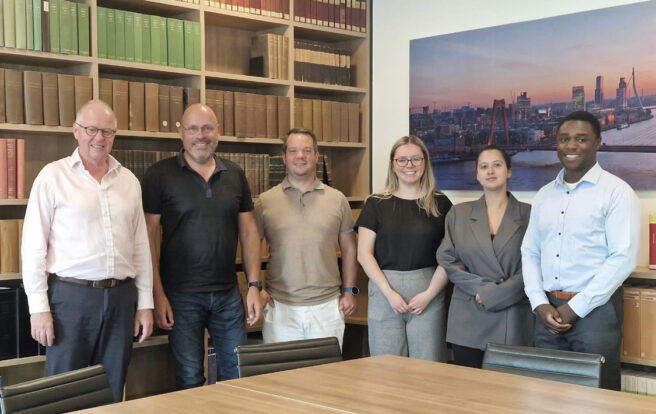
Third-year law student Tara Swanson is pictured with colleagues from her internship in the Netherlands at Conway Advocaat and Attorneys-at-law. Photo courtesy of Tara Swanson.

I’ve always enjoyed puzzles. Ever since I was a kid, I liked puzzles, logic games, brain teasers, anything that would challenge me. I still do the New York Times crossword every morning before I start my day and debrief about it with my dad. When I started my law school journey, I knew that this love of puzzles would be a factor in deciding which field I wanted to practice in. I discovered international law as a 1L and decided to set up a meeting with Professor Omar Dajani to speak about it. He talked about his experiences in international law, gave me a book to read about the field, and from that point on I was hooked. I knew that this was my path. International law was a giant puzzle, attempting to use different avenues of the law to make the pieces fit together and solve a complex problem. It was a match made in heaven.

The view from the top of the Hohensalzburg Fortress in Salzburg, Austria. Photo courtesy of Tara Swanson.

My journey to Salzburg however, started in January 2023 in Professor Dan Croxall’s office. I was struggling with what to do for my 2L summer and his answer was almost immediate; “Why aren’t you going to Salzburg?” I sat back and asked myself the same question. I had planned to participate in the Salzburg Graduate Study Abroad Program in the 2021-2022 school year, however the program had to be cancelled due to COVID-19. As someone who would be graduating with a Concentration in International Law and wants to practice international arbitration and litigation, the choice seemed easy. I wanted to work abroad one day, what better way to get some experience and be sure this was truly the field for me. I emailed Assistant Dean Clémence Kucera that day to express my interest in the program and it ended up being the best decision I would ever make.

The view from lookout point at Schloss Hellbrunn in Salzburg, Austria. Photo courtesy of Tara Swanson.

Fast forward to May, I landed in the Netherlands (on my 26th birthday) and had never been more nervous in my life. I didn’t speak a word of Dutch, had never been outside the United States before, and was 5,387 miles away from my friends and family. I would be spending six weeks in Rotterdam with Conway Advocaat and Attorneys-at-law as a law intern learning all about international arbitration and then three weeks in Salzburg, Austria taking classes. I had only ever studied international law in the classroom and was anxious to see it in practice and get the chance to put my knowledge to use. As the weeks passed by, the anxieties fell away and I focused on learning as much as I could about the practice of international arbitration, witnessing firsthand its intricacies and nuances. I also began to deeply admire the Dutch way of life. Everyone at my firm worked hard, but they also understood the importance of a work-life balance. Daily walks after lunchtime became the norm and I had the privilege of getting to know the associates as friends, in addition to colleagues. I also got the opportunity to travel and see Amsterdam, The Hague, Vienna, and Venice, and foster so many new friendships. This program is so unique in the opportunities it provides, and I’m so grateful I got the chance to be a part of it.

By Tara Swanson, a third-year student at McGeorge School of Law. 

Selena Martinez is a third-year student at McGeorge School of Law. 

I decided to go to law school to help others within my community. I never wanted anyone to feel they could not help themselves out of a bad situation. It was not until after attending McGeorge School of Law that I realized there was a legal clinic to serve the underrepresented Sacramento community. Given the wide variety of options to get involved, I ultimately decided to go into Bankruptcy Law to help others receive a fresh start and learn how to manage their funds properly. I have always been interested in business, and bankruptcy is a great segway to attain a Business Concentration.

I have been fortunate throughout my law school career to participate in the Bankruptcy Clinic as a certified law student, a work-study employee, and now as a Team Lead for the fall 2023 semester. The Bankruptcy Clinic is an excellent opportunity for hands-on experience working with clients. My clients have been so grateful for the Clinic’s help and services, allowing them to regain their footing.

The Clinic primarily deals with Chapter 7 Bankruptcies, known as the “fresh start.” Chapter 7 is generally for individuals with consumer debts and the quickest way for the debtor to receive a discharge. The debtor’s assets are then liquidated to pay their creditors, and the entire process usually takes about four months.

Throughout my involvement with the Bankruptcy Clinic, I have helped two clients receive their discharge and assisted in all aspects of their cases. I interviewed, counseled, and represented clients before the U.S. Bankruptcy Court of the Eastern District of California. Participating in the Meeting of the Creditors with the Trustee and gaining knowledge in reaffirmation hearings has been an asset in obtaining other employment opportunities.

The Clinic allows you to draw on your experiences in the classroom and refine your skills for practical experience. I have taken the knowledge I have learned in the Bankruptcy course and Client Interviewing and Counseling and have been able to exercise my skill set during my interviews with clients and during the Meeting of the Creditors. Community Legal Services provides McGeorge students with a safe space to achieve practical experience and help represent indigent individuals within our community.

I have had such a positive experience within the Clinic. Professor Warren Jones, the supervising attorney for the Bankruptcy Clinic, has extensively mentored me and other students. I highly recommend getting involved with the Bankruptcy Clinic or any clinic; it has been the highlight of my law school career.

By Selena Martinez, a third-year student at McGeorge School of Law.