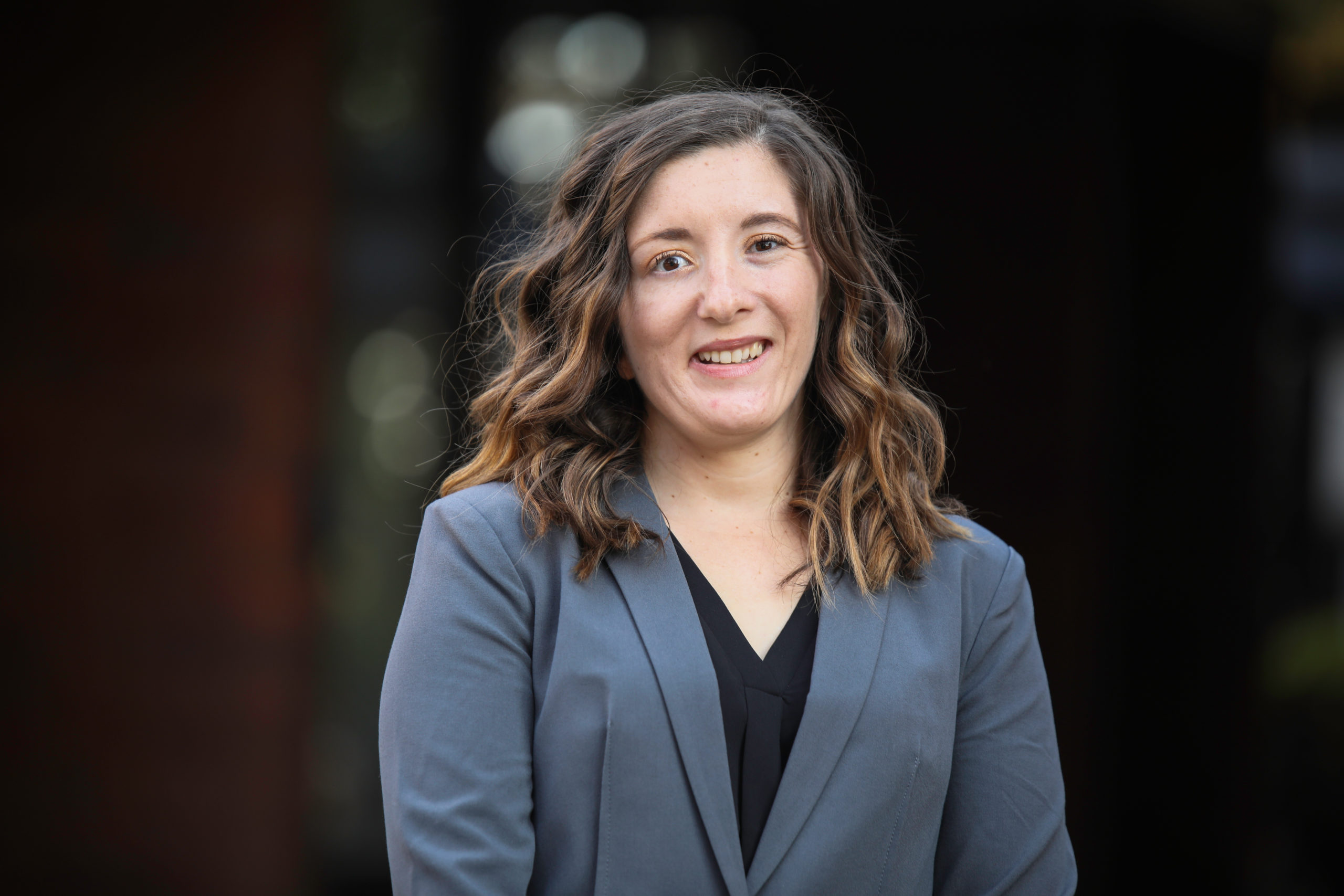
Michael Crisostomo, ’22, came to McGeorge to get the benefits of a small campus community – engaged classmates, faculty who know your name, and an active alumni network. He’s using his experiences as President of McGeorge’s Student Bar Association and a member of the Capital Lawyering Concentration to prepare for work in private practice followed by a career in lobbying.

Learn more about:
Far too often, people experiencing homelessness don’t feel seen. It’s been described to me as feeling like a ghost; you’re there, but nobody sees you. Instead, those experiencing homelessness are put in the unenviable position of trying to meet their basic needs in a world where people turn away from their suffering because it’s easier to pretend the problem isn’t there. Therein lies the reason I was drawn to doing my clinic work at McGeorge’s Homeless Advocacy Clinic; I want to do my part to make sure that the homeless in our community feel truly seen.

I’ve been working at the Homeless Advocacy Clinic twice a week since the school year began last August. The work has been a very fulfilling experience. As a Certified Law Student, I have learned many valuable skills – client interviewing and counseling, case management, oral and written advocacy, and office procedures associated with working in a law office.

The best part about working at the Homeless Advocacy Clinic has been forming relationships with the other six student attorneys and with our supervising attorney, Professor Ron Hochbaum. I love that my colleagues and I all have different backgrounds, interests, and skills, making it more fun to collaborate.

Professor Hochbaum allows us to manage our cases, including decision-making authority in most situations, even allowing us to make mistakes as part of our growth process. I’m grateful for his guidance and support, which have been instrumental in developing my lawyering skills throughout my Homeless Advocacy Clinic experience. Additionally, Professor Hochbaum has been very responsive to my needs and feedback. His door is always open for everything from questions to needing to vent.

I believe that the homelessness crisis is one of the most pressing social justice issues across the country. Public benefit programs are often overly complicated to apply for, let alone get approved for. Other public policies treat homelessness as a nuisance for housed residents rather than a societal problem that needs solving. These are the areas where the Homeless Advocacy Clinic provides assistance. We advocate for the best possible outcomes for our clients and always have their best interests in mind.

“You must be the change you want to see in the world,” Mahatma Gandhi is purported to have said. This is why it is essential to give back to the community. At one point or another, we all need a helping hand. We just need someone to see us first.

By Brian Taghadossi, a second-year law student at McGeorge School of Law.


One of the main reasons I applied to University of the Pacific McGeorge School of Law was the Legislative and Public Policy Clinic. I had been working in and around the Legislature for about six months when I began applying to law schools, and I saw that McGeorge School of Law had a lot of offerings for people who wanted to engage with and learn more about the legislative process. When I learned about the Clinic, I knew right away that if I got into McGeorge it would be something I had to do. The opportunity to propose and pursue a new public policy that I truly cared about was a dream come true for me.

In my second year, I took Lawmaking in California, a course where you get to write a bill of your own creation. I decided that I wanted to write a bill that would try to address the problem of unpaid internships in state government. I knew from experience the frustration of working for no pay, the feeling that I was not valued even though I was contributing valuable labor, the anger that no generation before mine was told they weren’t worth paying, and the gall at those who’d tell me that “experience” was just as valuable as paid compensation.

At that time, I had been an unpaid intern in the Manhattan office of Sen. Chuck Schumer, twice in the California State Assembly, and most recently for the California Department of Public Health’s legal office. As of now, with yet another unpaid internship under my belt, I’ve put in nearly 1,500 hours of work as an unpaid intern. Even at the federal minimum wage, I’ve missed out on nearly $10,000 of earnings, and I’m one of the lucky ones privileged enough to have taken these internships at all. You can’t pay rent with experience.

When the Clinic started, I knew I wanted to pursue this further, and now we have a wonderful sponsor, Pay Our Interns, as well as a proposal to address this glaring gap between our values as a state and the status quo. The Clinic has taught me many things, but most of all I’ve learned the importance of constant communication with your allies and moving with purpose. The process moves quickly and there are a lot of people competing for time and attention, so it’s crucial to stay on top of new developments and adapt. Having great partners that you can rely on makes all of it much easier, so I really have to thank Matt Urban and Mark Cayaba for all their help, as well as everyone at Pay Our Interns who have been incredible throughout the process.

To anyone at McGeorge or applicants interested in policy and government, I highly recommend participating in the Clinic. You won’t be disappointed.

By: Steven Weiss, third-year law student

Mathew Olson received a Master of Public Administration from the University of the Pacific McGeorge School of Law in 2018. In this video, he talks about what made McGeorge stand out to him during the application process, the hands-on experience he gained at McGeorge, and the school’s professional network. 

Learn more about McGeorge School of Law’s MPA Program.

Robert T. Eglet, ’88, is a senior partner at Eglet Adams in Las Vegas, Nevada, and one of the most successful civil trial attorneys in the United States. He recently gave McGeorge School of Law a $25 million estate gift, with more than $20 of that dedicated to scholarships for students of color and first-generation law students. In this video, Eglet talks about what inspired him to be a trial attorney and what inspired him to give back to his law school in the way that he did. You can learn more about the donation made by Robert Eglet and his wife and law partner, Tracy Eglet.

Learn more about McGeorge’s Trial Advocacy Center that his gift is also supporting here. If you are able to do so, and feel so moved, you can donate to McGeorge School of Law.

Trey Hunter, ’19, came to McGeorge from Austin, Texas to earn his MPA degree. He talks about what sets a McGeorge MPA apart from degrees at other institutions, and why McGeorge’s location in Sacramento, California is such an added value to his graduate education.

Learn more about McGeorge’s MPA and MPP degrees.

Studying Public Health as an undergraduate student exposed me to many policy questions that sparked my passion for public policy. I became interested in the social determinants of health, how a person’s surroundings socially intersected with all aspects of their health. With the understanding that policies shape the environments we live, work, and interact with others on a daily basis made me want to do something to influence policies to improve health outcomes. That understanding and passion are the reasons I decided to go to law school.

I chose the University of the Pacific McGeorge School of Law for its Capital Lawyering Concentration and the Legislative and Public Policy Clinic. Knowing I wanted to go into public policy, I used my time at McGeorge to prepare me for a career in public policy.

I knew the Capital Lawyering Concentration’s focus on preparing students to go into government and other related public policy careers was the best choice for me. The opportunity to have practical experience working in the legislative process through the Legislative and Public Policy Clinic was an added bonus. I knew being a part of it would be an unparalleled experience.

The clinic is for third-year students, so I set my sights on participating in the clinic from my first day at McGeorge. I built my academic resume during my time at McGeorge to best prepare me for participating in the clinic during my third year. Going into the clinic with a solid foundation of how the bill making process works has allowed me to engage with legislative staffers and know what to expect when my bill is up in committee or goes to the floor for a vote.

That said, I wasn’t sure what to expect when I actually started in the clinic; being in the clinic has exceeded all my expectations. It is rewarding to be surrounded by knowledgeable professors who know the process and fellow students just as driven to make positive changes through legislative action.

Participating in the Legislative and Public Policy Clinic has taught me many practical skills I will carry into a career in public policy. I now have practical experience turning an idea into legislative language and pitching a bill to policy makers and legislative staffers. Moving a bill through the legislative process has allowed me to use the theoretical information I have learned in other classes and now apply it in real-world situations.

In addition to observing the legislative process from the inside, I am making connections in the building that I will be able to utilize going forward in my career. In a networking-based career, having the opportunity to build my network while I’m still in school is incredibly useful and will serve me well in the future.

Ultimately, the most rewarding aspect of the clinic is knowing that a simple idea my colleague and I had at the beginning of the year may bring about an actual legislative change.

By Mo Roeckl-Navazio, third-year law student

Morgan Gross is a first-year law student at the University of the Pacific McGeorge School of Law. In this video, Morgan Gross, JD ’24 discusses what led her to apply for law school, what drew her to McGeorge School of Law, living in Sacramento, and her interest in public policy. Learn more about McGeorge School of Law.

Sydnie Reyes, ’19, saw her passion and life path come together at Pacific while pursuing an undergraduate degree in psychology with a minor in prelaw on Pacific’s Stockton campus and then at McGeorge School of Law.

Reyes chose McGeorge for its focus on public policy, legal program, and financial aid support. But ultimately, she wanted to make a difference in people’s lives, which led her to pursue a law degree at McGeorge.

While on the Sacramento campus, Reyes was president of the Latino Law Students Association and was instrumental in creating the groundbreaking Center for Inclusion and Diversity, a student-led “safe space” that promotes diversity, leads trainings and provides a community for minority and first-generation students. She worked as a certified law clerk with the Federal Defender of the Eastern District of California, as a certified legal intern with the Sacramento County Public Defender’s Office, and as an intern for a Supreme Court Justice in Guatemala. Her endeavors earned her a nomination for the 2019 National Jurist Law Student of the Year award from McGeorge.

– Article was originally published in the 2021 University of the Pacific Magazine.

Alexander Lee is a fourth-year evening student at the University of the Pacific McGeorge School of Law. In this video, he talks about what made McGeorge stand out to him when he was choosing a law school, the school’s award-winning Capital Lawyering Concentration, the school’s part-time program, and the McGeorge community.

Learn more about McGeorge School of Law.

Learn more about the Capital Lawyering Concentration.