
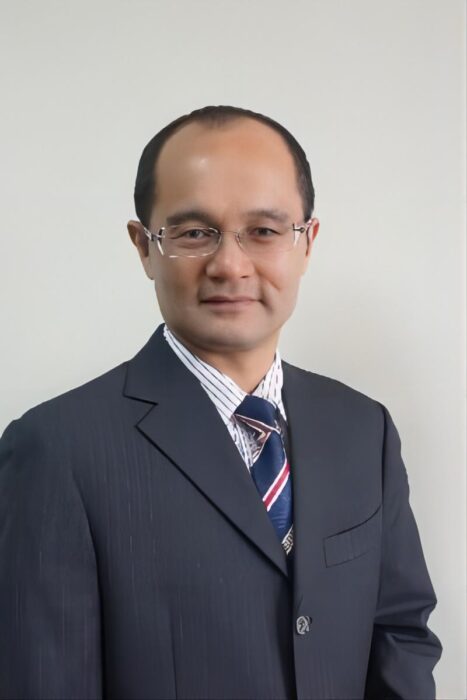
Welcome to Henry Liao (LLM ’98), who practices in the corporate law field in Guangzhou, China, and is a member of McGeorge School of Law’s International Board of Advisors (IBOA).
1. Henry, you are both a member of the IBOA and the Action Committee that takes on special projects. With a busy, full-time practice, why did you decide to devote some of your time to the international programs at McGeorge School of Law?
As an international student myself over 20 years ago, I had a valuable, rewarding, and gratifying experience with McGeorge School of Law. The knowledge I gained from McGeorge paved my way to practice in intricate cross-border transactions. The unconditional help I received from the affable faculty turned into lifelong friendships. As a proud and grateful member of the McGeorge international family, I have always been looking to return the favor and make my due contribution to McGeorge. From my experience, I am confident that McGeorge has strong international programs and can provide international students with lifelines for their legal careers.
With that always in mind, I have successfully referred several candidates to McGeorge international programs over the years. When I was invited to join the IBOA and the Action Committee and had an opportunity to discuss our plans and objectives with other members, I realized their goals met with mine. I have no doubt our collective efforts will broaden the exposure of our program to the international world and bring in more candidates in the future. I am honored and excited about the opportunity to share my thoughts about promoting our programs and reciprocate what I received from McGeorge.
2. Could you please describe your practice and some of the issues that you have found the most interesting over the years?
My practice includes cross-border transactions, such as IPOs (initial public offerings), M&A (mergers & acquisitions), FDI (foreign-directed investments), and project financing. I also have extensive experience in advising multinational companies, mid-sized companies, and start-ups in their IPR protections and enforcements, such as in trademark, copyright disputes, and patent litigations.
Over the years, I have found some of the issues to be most interesting. For example, the roles played by the U.S. Securities and Exchange Commission (“SEC”) and the China Securities Regulatory Commission (“CSRC”) are very different in the process of IPOs. The SEC will treat counsel as professionals and pay due respects as kind of peers while the CSRC will treat counsel as their subordinates. In addition, it is quite rare for the CSRC to issue something in writing (if any), such as non-action letters, while we usually seek the non-action letters from the SEC, and such requests are not often denied if we can lay good and solid grounds. Furthermore, the SEC limits its scope of reviews of disclosure documents. Most of the time, the SEC will conduct formal reviews only. For example, the SEC has very strict requirements regarding how the disclosure documents shall be drafted: you have to use positive sentences instead of passive sentences whenever possible. In other words, you are required to use simple and plain English. On the contrary, the CSRC would not hesitate to send its staff or summon issuers, CPAs (certified public accountants), and counsel to conduct substantive reviews of the disclosure documents in its regional offices, especially when China established its stock exchange markets.
Another interesting issue is in the area of enforcement. Enforcement of judgments used to be very challenging in China. Many years ago, we obtained a favorable judgment on behalf of Otis Elevator Company (a U.S.-listed company and one of the largest elevator manufacturers in the world) against an infringer in software infringement.
When we applied for the enforcement of the judgment, we could not locate any assets or the infringer. When we had almost given up, we got a call from the presiding judge enforcing the judgment informing us that someone else was willing to comply with the judgment on behalf of the infringer.
This gentleman is from the U.S. and is the uncle of the infringer. When he came back to his hometown from the U.S. and heard about the case, he contacted the presiding judge and learned that he could comply with the enforcement on behalf of the infringer. There were two parts of enforcement of the judgment: one was the monetary compensation. That is, the infringer was ordered to transfer the compensation to the court’s designated bank account. Upon receipt of the compensation, the court would transfer the compensation to Otis’ bank account. Another was the injunction. The infringer was ordered to stop the infringing activities. The uncle complied with the enforcement and transferred the compensation to the court. This is permitted in China and will not affect the credibility of the gentleman. On the contrary, the gentleman received a letter of praise from the court.
Through the contact with this gentleman, we learned that a judgment must be enforced in the U.S., otherwise, the person who fails to comply with a valid and final judgment could be put on the blacklist. Without a good credential, a person in the U.S. could hardly have a good living. For example, such a person could not borrow any money from a financial institution. From this case, I understand that we human beings are products of our environments: if you are living in a society governed by the rule of law, you could be a good citizen, at least, you will hold due respect for the law and order, thus, follow the rules. As counsel, we must be experts not only in the law but also in the society in which we are living.
3. What stands out for you from your LLM experience at McGeorge?
I benefit a lot from my LLM experience at McGeorge, at least from two aspects.
When I applied for the JD program at the University of Michigan Law School, my good scores at McGeorge helped me to be admitted because I could not obtain my GPA for my bachelor’s degree from Sun Yat-sen University in China (in 1999, the communications were not that convenient as nowadays). Michigan Law School allowed me to use my transcripts at McGeorge as a reference.
During the LLM program, I was fortunate enough to have my internship at a local firm in Chicago (Holleb & Coff, one of the biggest in Chicago at the time, though it does not exist anymore). I was invited to participate in an IPO project. The firm represented the issuer. From my participation, I gained first-hand knowledge about a counsel’s role in the IPO process. I was also lucky enough to be sitting for a discovery process, which is unique in the U.S. judicial system. I was asked to attend a hearing in the Cook County court and had the opportunity to share my legal practice experience in China with a judge there. To sum up, my experience accumulated in the firm made me stand out from most of my schoolmates at Michigan Law School because most of them were new graduates from college.
4. What advice do you have for students and young lawyers who want to go into an international corporate practice?
For starters, they need language skills. English is the primary language in the international business world. To go into an international corporate practice, you are expected to be able to communicate seamlessly in English in both legal and commercial settings. Most international students are at least bilingual, speaking both English and their respective primary languages. I suggest they keep working on their English proficiency after they return to their home countries.
They also need relevant legal knowledge, including corporate law, contract law, labor law, international trading, foreign exchange regulations, international taxation, intellectual property prosecution, and information privacy. Please note that the list of courses I provide is not exhaustive. Each international corporation faces distinctive legal challenges in different business sectors and different jurisdictions. If students are interested in a specific sector or a particular international corporation, they should look into the business dealings of such sector or corporation to learn their common legal challenges. If they can not only identify the legal problems but also provide a solution when pitching the client or having a job interview, they have a good chance of landing the job.
Last but not least, networking. Many job positions are filled through referrals and connections rather than public recruitment. It is the same as finding a lawyer for legal problems. Clients would prefer a referral from someone they are familiar with. To build up your network, just try whatever you can and every means available, as long as it is legal: For instance, joining a professional association, attending social events, maintaining contacts with alumni, or making connections on professional social media are all worth trying.
5. Do you have any suggestions on what the IBOA can do, in addition to this newsletter, to connect international alumni in similar areas of practice or regions?
I suggest that we invite international alumni and their firms from different states and countries to form an association. Within this association, we update each other on the latest developments in legal practices in respective jurisdictions, we share constructive management experience to improve productivity and profitability, we offer internship and job opportunities to alumni, and we enable a referral system that fulfills clients’ cross-border legal needs. As to the referral system, when clients of a member firm are looking for legal services from other jurisdictions, the referring firm makes it known to other member firms through the mechanism of the association. In the case of a cross-border project, firms from different jurisdictions may join to pitch the project whereby a small local firm may be able to compete with the BigLaws. Even if it is a purely foreign matter, a gratis referral earns the referring firm more exposure among other members and may lead to future cooperation. Pragmatic benefits such as job opportunities and business referrals will attract more alumni and firms to join the association and in turn, bring in more referral opportunities.
If you would like to be in touch with Henry, you can reach him at [email protected].